




Carey Chen, Chief Executive Officer & Executive Director of the American Welding Society
If your manager asks you for a performance review, make sure you are ready to answer the key question: What value do you bring to the organization?
For AWS, that question is often framed a little differently: Why would someone join AWS as a member or volunteer? Before I answer that question, it’s important to look at the broader forces reshaping our industry and the opportunities those forces create for both AWS and GAWDA members.
We are living through a period of rapid change. Global megatrends are transforming the welding workforce, accelerating technology adoption, and redefining how value is created across the supply chain. Those same trends also guide how AWS is investing, modernizing, and evolving to better serve our members.
GLOBAL MEGA TRENDS SHAPING WELDING’S FUTURE
Change presents opportunity, and several global megatrends are opening doors for new services, new business models, and new forms of collaboration. I group these trends into two overlapping categories — skills gap/workforce development and welding technology — because they are deeply interconnected.
- The “silver tsunami.” The welding workforce is aging rapidly. Large numbers of experienced welders are nearing retirement, and the industry faces an urgent need to attract, train, and retain younger generations. AWS workforce data clearly shows that replacement demand, not just growth, is driving hiring needs.
- A chronic welder shortage of roughly 80,000 people annually. Decades of underinvestment in vocational education created a structural undersupply of skilled tradespeople. The encouraging news is cultural: younger generations are rediscovering the value of skilled trades, seeing viable career paths that don’t require the cost or debt of a four-year college degree.
- Credentialing and micro-certifications. Employers need skilled people now. They can’t wait two or four years for traditional education pipelines. This fuels demand for stackable, modular, and portable credentials that validate specialized welding skills, automation skills, and real-world performance.
- New learning models. Digital solutions for training and skills assessment are becoming mainstream. The most effective approaches combine hands-on training with online learning theory, allowing education to scale, reach remote learners, and adapt to different learning styles.
- Emerging markets. The global supply of certified welders is shifting toward countries such as India, the Philippines, and Vietnam. This shift increases the importance of globally recognized and portable certifications that ensure consistent standards.
- Automation and mechanization. The surge in robots and cobots supporting human welders accelerated at FABTECH 2022 and has grown exponentially since. With that growth comes demand for multi-skilled workers who can program, operate, maintain, and troubleshoot automated systems.
- Smart manufacturing and Industry 4.0. Welding systems are increasingly connected, enabling real-time quality monitoring, digital recordkeeping, and predictive maintenance. Fabricators are adopting AI and data analytics, but success depends on welding personnel who possess digital literacy and data-interpretation skills.
- Advanced welding technologies. Handheld laser welding systems are now mainstream, joined by laser hybrid, ultrasonic, and friction stir welding processes. These technologies enable improved joining, particularly for advanced materials such as composites and high-performance alloys. Training must evolve accordingly.
- Additive manufacturing. Welding principles are foundational to Directed Energy Deposition (DED) and wire-arc additive manufacturing (WAAM). These automated processes are creating new hybrid roles that blend the skills of welders, technicians, designers, engineers, and automation specialists.
- Sustainable and green welding. Large manufacturers now operate under formal ESG (environmental, social, and governance) mandates. Energy efficiency, emissions reduction, fume control, and waste minimization are strategic priorities.
WHAT THESE TRENDS MEAN FOR DISTRIBUTORS
With a bit of creative thinking, these megatrends open meaningful business opportunities for distributors. Increasingly, distributors are not just product suppliers; they are strategic partners helping customers adapt and compete. Opportunities include:
- Operator training and education for new welder hires, leveraging AWS education resources.
- Advanced consulting and training on lasers, automation, AI-enabled quality control tools, analytics software, and additive manufacturing. For most fabricators, the top challenges remain workforce availability and profit per employee.
- Skills validation and credentialing, including becoming an AWS Accredited Testing Facility.
- Procedure development for laser and automated processes, which unlocks significant incremental sales in gases, filler metals, and PPE by enabling customers to double or quadruple throughput.
- ESG advisory services, such as energy-efficiency audits, low-fume consumables, and waste-reduction strategies.
After more than 30 years in manufacturing, I’m confident these trends will shape our future. The United States advanced beyond other nations because leaders invested in core infrastructure. Historically, that meant roads, bridges, and buildings. Today, it also means digital and technological infrastructure.
This new infrastructure requires collaboration between blue-collar and white-collar roles. With a foot in both worlds, the welding supply chain is uniquely positioned to bridge that gap and help customers capitalize on change.
AWS ENHANCEMENTS: FOCUSING ON THE VITAL FEW
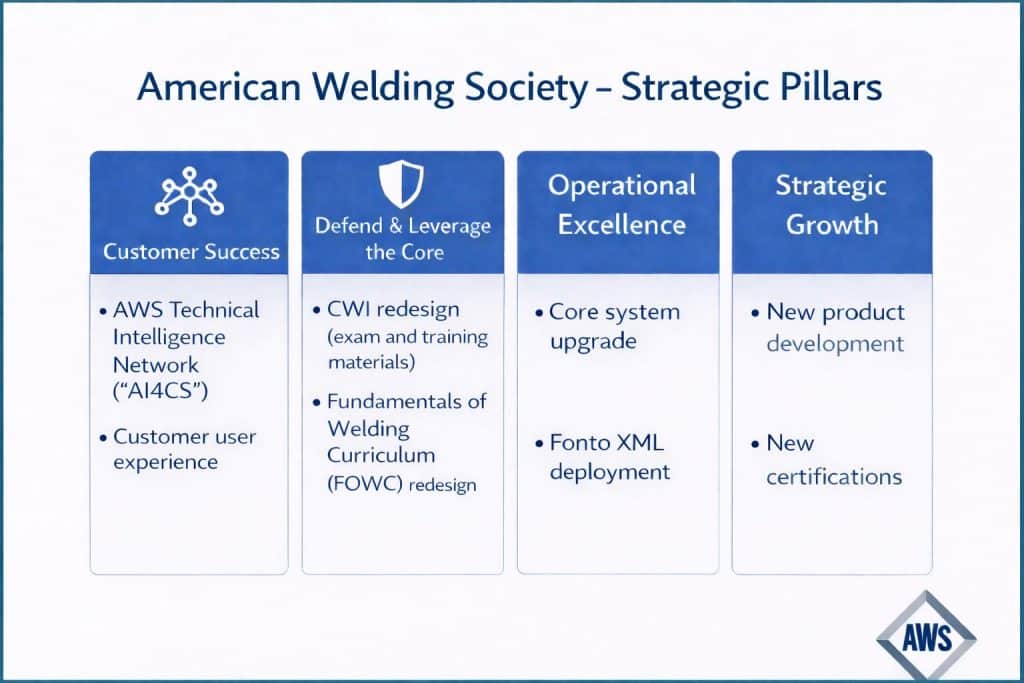
I’m a mathematician by training, which means I believe the order in which you solve problems matters. As a leader, I focus on what I call the vital few. Like finding the four corners of a jigsaw puzzle, AWS is aligning its resources around four strategic pillars.
AWS will focus its resources in four key areas. In 2026, our goal is simple: make customers and members feel successful by understanding their challenges and delivering solutions that exceed expectations.
For example, many members of the AWS Welding Equipment Manufacturers Committee (WEMCO) are also part of GAWDA. This year, both groups will hold their meetings in Oklahoma City — the WEMCO Annual Meeting from May 15 to 17 and the GAWDA Spring Management Conference from May 17 to 19. Hosting these events at the same place allows WEMCO members to avoid extra travel.
The Certified Welding Inspector (CWI) program is another example. We recognize that certification and renewal can be stressful. Over the next two years, AWS will roll out new CWI training materials, a redesigned exam, and a streamlined renewal cycle to create a more modern, customer-centric experience.
AWS is also modernizing its education portfolio. The Fundamentals of Welding Curriculum (FOWC) currently exists in a largely analog, textbook-based format. Over the next two to three years, AWS will invest significantly to update FOWC with new technologies, augmented reality, virtual reality and video, which reflects how people actually learn today (proven by the meteoric rise of online welding influencers and their how-to videos).
Behind the scenes, AWS is upgrading core systems, including accounting and customer relationship management platforms. We are also deploying Fonto XML, a structured authoring system that allows complex technical documents to be updated once and automatically synchronized everywhere they appear. This dramatically improves efficiency, accuracy, searchability and AI readiness, which benefits volunteers, members and users alike.
THE VALUE OF AWS: THE SIX CS
Returning to the original question — How does AWS add value? — I’ve been thinking about that since I began volunteering with AWS in 2007 and my subsequent leadership roles within the organization.
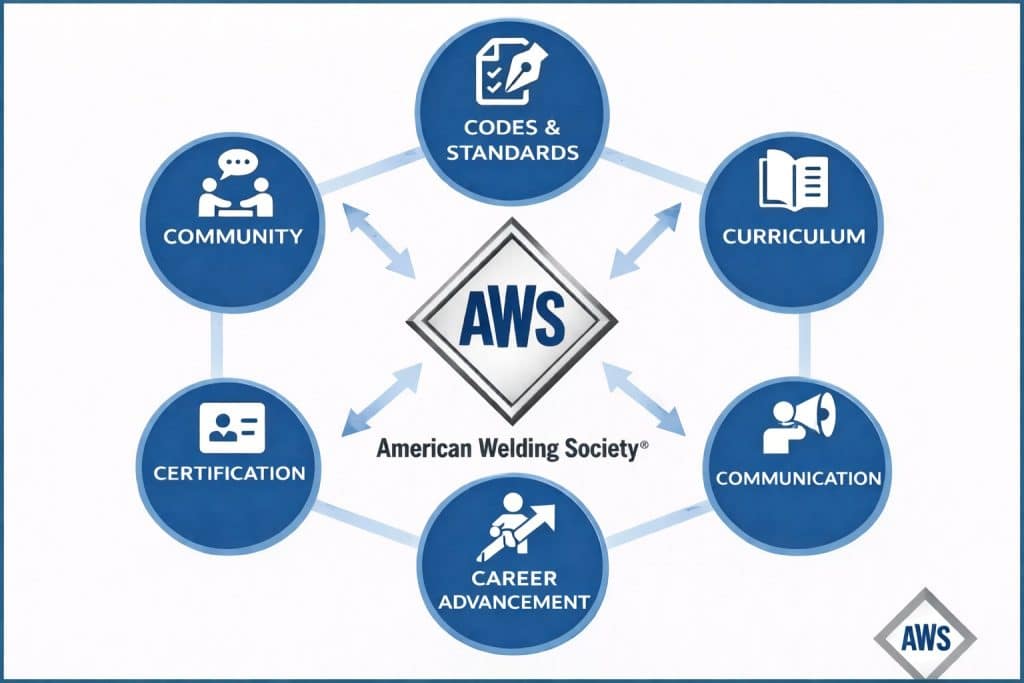
When I interviewed for my current role, I distilled AWS’s value into an “elevator pitch”: AWS delivers value through the six Cs: codes and standards, community, certification, curriculum, career advancement, and communication.
AWS was founded in 1919, underscoring welding’s importance during World War I and the urgent need for standardization. Unlike OSHA, which is a government-funded agency, AWS is an independent 501(c)(3) organization that convenes industry to develop voluntary consensus standards. Codes naturally create community. On AWS committees, fierce competitors collaborate to create standards vital to safety, quality and national infrastructure. That community extends through conferences, sections, student chapters, and online forums. As an AWS member, you are often just one or two connections away from solving a problem or advancing a career.
With codes comes certification, supported by a comprehensive curriculum. Together, these elements have supported millions of welding careers over the past century. To support the future, the AWS Foundation has awarded more than 18,000 scholarships since 1993, totaling more than $15 million.
VALUE THROUGH CONNECTION
AWS exists to connect people to standards, education to careers, technology to skills, and today’s workforce to tomorrow’s opportunities. As megatrends reshape manufacturing, AWS and welding distributors have a unique opportunity to lead together.
Distributors don’t just sell products; they enable productivity, workforce development, and technology adoption. AWS provides the framework through the six Cs that allows transformation to happen at scale.
If we collaborate, innovate, and stay focused on delivering real value, 2026 can be a year of opportunity — for AWS, for distributors, and for the entire welding industry.